Conditions › Respiratory
Pulmonary Embolism Nursing Care Plan and Interventions
Suspected pulmonary embolism is an emergency: raise the head of the bed, give oxygen, stay with the client and notify the provider, then prepare for CT angiography. Anticoagulants are the mainstay (heparin drip by aPTT, then a DOAC or warfarin), with thrombolytics for massive PE and bleeding precautions throughout.
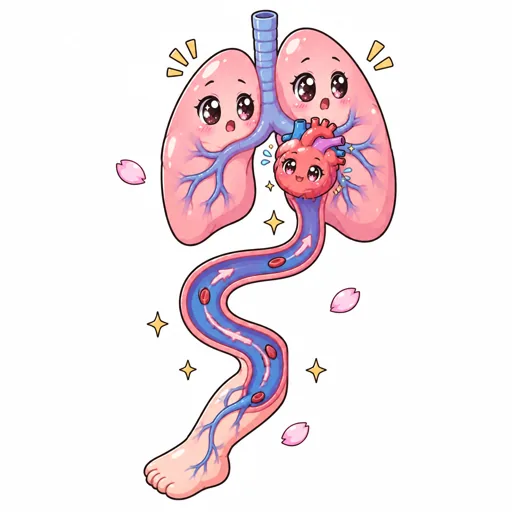
Pulmonary embolism nursing care plan
| Nursing problem | Goal | Key interventions |
|---|---|---|
| Impaired gas exchange | SpO2 at goal, RR and HR coming down. | |
| Decreased cardiac output (massive PE) | BP stable; right heart strain caught early. | |
| Risk for bleeding (anticoagulants, thrombolytics) | aPTT or INR in range; no bleeding. | |
| Health maintenance: needs teaching | Takes every anticoagulant dose and reports bleeding signs. |
Problem wording is plain-language nursing diagnosis style. Your program may require NANDA-I labels and your own assessment data.
What it is
PE: what it is
A clot, usually from a leg or pelvic DVT, lodges in a lung artery. That lung tissue gets air but no blood, so oxygen drops. 1,2
Air without blood flow is called a ventilation/perfusion (V/Q) mismatch.
Who is at risk
A past DVT or PE, recent surgery, bed rest or immobility, cancer and chemotherapy, and drugs or gene changes that make blood clot. 1
Any risk for a DVT is a risk for a PE: the clot usually starts in the legs.
Assessment: what you will see
Cues: sudden shortness of breath
Sudden shortness of breath, sharp chest pain on breathing in, fast heart rate, anxiety. Sometimes a cough with bloody sputum. 1,2
Sweating and dizziness can come with it. In older adults, new confusion may be the first sign.
Vital signs in PE
A fast heart rate and hard, fast breathing are common. SpO2 may be low, or may drop only when the client walks. 1,2
A normal SpO2 does not rule PE out. An unexplained fast heart rate is a clue on its own.
Confirming it: CT angiography
CT pulmonary angiography shows the clot within minutes. A negative D-dimer helps rule PE out when suspicion is low. 1,2
A positive D-dimer doesn't prove a PE. A V/Q scan is sometimes used instead of CT.
Complications and red flags
Massive PE: the right heart fails
A big clot raises pressure in the lung arteries. The right ventricle can't pump against it: low BP, fainting, cardiac arrest. 1,2
Low blood pressure in PE means shock. This is the client who may need a clot-dissolving drug.
Priority: what the nurse does first
Suspected PE: first actions
Sit the client upright, start oxygen, check vital signs and oxygen saturation, and call for help now. 3,1
Oxygenation and a stable blood pressure are the priority. The scan comes after.
Nursing interventions and treatment
Thrombolytics for massive PE
Alteplase dissolves the clot fast. Mainly for massive PE: low BP that persists despite fluids. Bleeding is the main risk. 2,4
Screen for contraindications first, then watch closely for bleeding, especially at puncture sites.
Can't anticoagulate? IVC filter
A filter in the inferior vena cava catches leg clots before they reach the lungs. Used when anticoagulants can't be given or fail. 2
A filter blocks the path. It doesn't dissolve the clot already in the lung.
Anticoagulants: the mainstay
Started as soon as PE is diagnosed or strongly suspected. They stop the clot growing and new ones forming while the body breaks it down. 2,4
They don't dissolve the clot. Only a thrombolytic does that, and it's saved for massive PE.
Heparin drip: follow the aPTT
A weight-based IV drip adjusted to keep the aPTT about 1.5 to 2.5 times baseline, usually checked every 6 hours. 5
Platelets down by half or more? Suspect heparin-induced thrombocytopenia and stop all heparin.
At home: DOAC or warfarin
DOACs such as apixaban or rivaroxaban come first: set doses, no routine INR checks. Warfarin is dosed to an INR of 2 to 3. 2,5
Warfarin takes days to work, so heparin or enoxaparin overlaps until the INR reaches goal.
Antidotes: protamine, vitamin K
Protamine reverses heparin. Vitamin K (phytonadione) reverses warfarin. 5
Push protamine slowly: giving it fast drops the blood pressure.
Client teaching
Teach: every dose, bleeding signs
Stopping early raises clot risk. Soft toothbrush, electric razor. Report black stools, blood in urine, bleeding gums, a severe headache. 5
A small bruise is expected on a blood thinner. Black, tarry stool is not: call.
Try a pulmonary embolism question
NCLEX-style, approved by a licensed RN. Pick an answer, check it, then read the rationale.
Question 1 · Pharmacological and Parenteral Therapies
A client is receiving a continuous heparin infusion for treatment of a pulmonary embolism. Which laboratory test does the nurse monitor to evaluate the effectiveness of this therapy?
Show answer and rationale
Answer: B. Heparin therapy is monitored using activated partial thromboplastin time (aPTT), which reflects the anticoagulant effect of unfractionated heparin. INR is used to monitor warfarin therapy, not heparin. Hemoglobin A1c reflects long-term glucose control and is unrelated to anticoagulation. Serum creatinine assesses renal function and does not indicate heparin's therapeutic effect, although platelet counts should also be monitored with both warfarin and heparin to detect heparin-induced thrombocytopenia.
Checked against: OpenStax Pharmacology for Nurses, 20.4; OpenStax Pharmacology for Nurses, 20.2
Keep studying pulmonary embolism in NurseLingo Pro
Pro has 13 pulmonary embolism questions like these, with a rationale for every answer. Everything for pulmonary embolism in one place. A free account gets 5 free opens of any condition; Pro opens all 277.
Test yourself: free med-surg practice questions with answers and rationales.
Frequently asked questions
What are the priority nursing diagnoses for pulmonary embolism?
Common nursing problems for pulmonary embolism include impaired gas exchange; decreased cardiac output (massive pe); risk for bleeding (anticoagulants, thrombolytics); health maintenance: needs teaching. Choose the ones your assessment supports and rank airway, breathing and circulation problems first.
What does the nurse do first for pulmonary embolism?
Sit the client upright, start oxygen, check vital signs and oxygen saturation, and call for help now.
Which nursing intervention is a priority for a patient suspected of having a pulmonary embolism?
Sit the client upright, start oxygen, check vital signs and oxygen saturation, stay with the client and call for help. Oxygenation and a stable blood pressure come first; the CT scan comes after. Then expect anticoagulation as ordered.
Do you give oxygen for pulmonary embolism?
Yes. Oxygen is one of the first actions for a suspected pulmonary embolism because the blocked lung area cannot exchange gas, so oxygen levels drop. Raise the head of the bed and monitor SpO2 and breathing closely.
What are the nursing responsibilities for a patient with pulmonary embolism?
Support oxygenation, monitor vital signs and SpO2, give anticoagulants as ordered (for example a heparin drip adjusted to the aPTT), watch for bleeding and teach the client to take every anticoagulant dose and report bleeding signs.
More respiratory
Related cheat sheets
Sources
- OpenStax Medical-Surgical Nursing, 16.6
- merckmanuals.com
- OpenStax Medical-Surgical Nursing, 27.3
- OpenStax Pharmacology for Nurses, 20.4
- OpenStax Pharmacology for Nurses, 20.2
For study only, not medical advice. Follow your program, your facility's policies and the provider's orders.